Burlesque, as we know
it today evokes images of extravagantly attired showgirls and
beautiful women disrobing in Martini glasses; fabulous singers with
voices that soar to the rafters; wonderful comedians reducing the
audience to tears of laughter. It is a beautiful, funny and
fascinating world with a rich history, stretching back as far as
human history.

Dita von Teese: the face of modern Burlesque
“Burlesque” The OED
tells us that the word derives from the Latin 'burla' meaning 'to
joke' and the French suffix '-esque' meaning 'in the style of'.
Therefore the word literally means 'In a joking style' or 'In the
style of a joke.' Despite the notions of burlesque as satire and
comedy being around for thousands of years, the word itself did not
appear until the early 16th Century, in the title of a
series of verses; 'Opere Burlesche'
by Francesco Berni, and it was not until the late 1870's in American
English that it came to be known as a 'variety show featuring
striptease'.

Opere Burlesche
The origins of
Burlesque are usually cited as being Ancient Greece – specifically
the playwright Aristophanes: his political comedies were aimed at
leading government or public officials and intended to challenge and
mock the contemporary social order. They were also considered rather
risque – take, for example, the play 'Lysistrata': the women of
Greece, tired of their men constantly marching off to war, withhold
sex as a means of convincing them to negotiate peace. It is a
political, social and sexual commentary that still holds appeal
today, despite being first performed around 411BC!


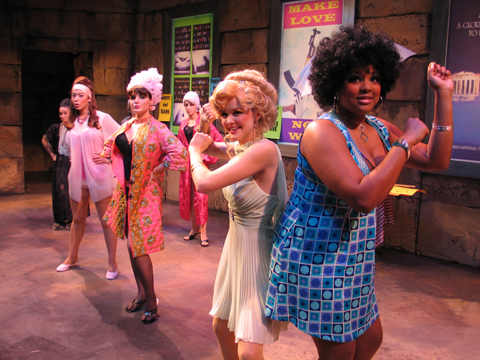
Lysistrata, and two modern interpretations
From there, we travel
to Medieval Italy and the tradition of the Commedia dell'Arte (the
closest translation, from the longer form of the title is 'Comedy of
the craft of Improvisation'). Travelling troupes of players would
journey through Italy, performing plays and skits using stock
characters, such as the innamorati
(the lovers) Harlequin and Columbine, and the zanni (the
clowns) among whom were characters named Pierrot, Pantalon and
Burlesque: each of whom embodied a different mood (ie: happiness,
mockery,etc). The plays themselves often had roots in Ancient Greek
tales, but were also drawn from current events, local news or the
political scandals of the day. As the plays were always improvised,
it would have been easy to change the action to suit regional tastes,
while still performing within the confines of the 'masks' or given
characters. Interestingly, during the Napoleonic reign over Italy,
Commedia was outlawed: maybe Napoleon was concerned about how he
would be portrayed! Commedia is also notable in that women were
usually part of the troupes, documented as early as the 1590's: women
were not allowed on British stages until the late 1660's after the
Restoration.

Commedia performers in their ubiquitous masks
Commedia
was just as popular, if not more so, in France during the 16th
and 17th
Centuries: characters were refined and stories became set, using folk
and fairy stories as their main influences. It is easy to see how
the English tradition of Pantomime developed from there.

Performers from the French School of Commedia
The
earliest recorded Pantomime show was produced at the Drury Lane
Theatre in 1702, and consisted entirely of dances and “dumb-shows”
(there was an odd law at the time that prohibited spoken word in
theatrical performances without special permission from Parliament
which was not repealed until 1843!) The first Pantomime – as we
would recognise it now – was Cinderella, again
produced at the Drury Lane Theatre around the mid-1800's. These
pantomimes followed a set structure: the Opening would introduce the
story (for example Aladdin or
Jack and the Beanstalk)
which would be followed by the Harlequinade: the lovers of the main
story would be transformed into Harlequin and Columbine, and the
action would become fast-paced and primarily visual with dances,
stage magic and music. The Harlequinade would feature four main
characters: the Harlequin (romantic male lead), Columbine (romantic
female lead), Pantalone (the evil man in power, often Columbine's
father) and the Clown, named... Burlesque. The night would end with
an Extravaganza in which all strands of the story would come together
to create a happy ending, utilizing magnificent props, special
effects, spectacular costumes and scenery, and a full-cast finale
number.

Victorian Pantomime Playbill
During the reign of
Queen Victoria, the word burlesque came to be associated with musical pastiche,
in which popular stories, operas, plays or ballets were parodied and
mocked, and Burlesques were produced, to much acclaim across London;
most notably by Madame Vestris at the Olympic Theatre. The shows
began as one-act pieces, as part of a longer variety show, similar to
the Harlequinade of Pantomime. Over time the Burlesque became an
entire evening's worth of entertainment, including risque jokes and
songs, dancing girls (in tights!) and bawdy humour.

Victorian drawing of Burlesque Dancers
The English style of
Burlesque was introduced to America with great success around the
late 1860's with the arrival of Lydia Thompson and her troupe of
'British Blondes'. The quick-witted Miss Thompson and her girls
caused scandal and outrage (one publicity story stated that a Russian
soldier, so smitten by Thompson, wrote her a love letter then placed
it, along with a glove of hers on his chest and shot himself through
the heart – unlikely but still lapped up by the American public!)
The shorter Burlesques of the English tradition, once across the
pond, were interspersed with other American variety acts such as
minstrel shows, acrobats or magicians, and the night would end with a
boxing match or a demonstration of exotic dancing.

Lydia Thompson: a forerunner of today's Drag Kings?
Briefly back to France,
and the Folies Bergere, which opened around 1869 – the French laws
on nudity were much more relaxed than anywhere in the world, and nude
revues soon became all the rage – dancers, singers and courtesans
flocked to the Folies, and later the Moulin Rouge (which opened in
1889) and both attracted stars such as Cleo de Merode, Josephine
Baker, Mistinguette and Loie Fuller.
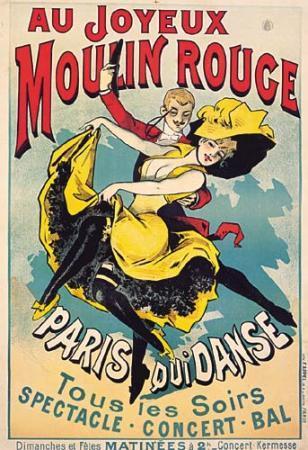
Vintage Moulin Rouge Poster
By the early 1900's in
America, focus in Burlesque shows was mainly on the dancing girls and
featured soubrettes who would show off their figures in tight dresses
or revealing costumes, and entertain with singing and dancing: some
girls would move more than others, but the ones who were less skilled
at dancing often compensated with more elaborate costuming. The most
famous Burlesque revues were the Ziegfeld Follies and the Minsky's
Theatre: Flo Ziegfeld had been inspired by the Parisian Folies, and
also possibly the British Pantomime Extravaganza with lavish sets,
gorgeous costumes and the glorification of the female form. The
Minsky's Burlesque were known as 'the poor-man's Follies' and included
more ribald jokes, raunchier dance routines and often quite literally
burlesqued the Ziegfeld Follies uptown.

Lucille Ball (American actress) began as a Ziegfeld Girl
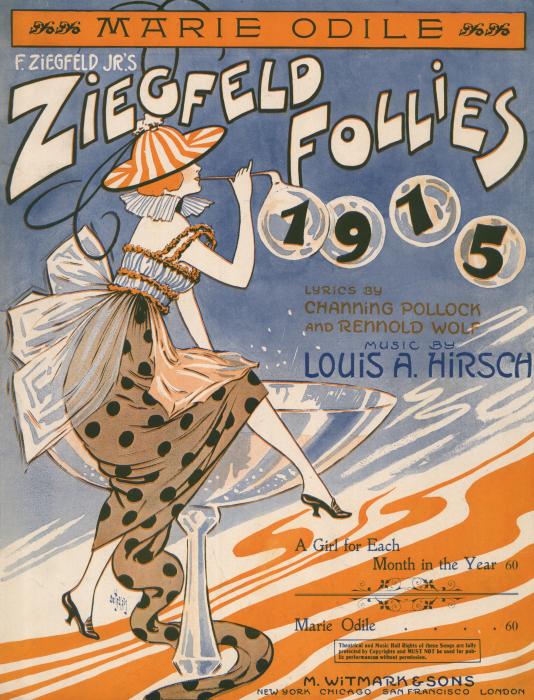

A Ziegfeld show poster from 1915, and a poster for the 1946 film
In variety shows all
over the USA, burlesque girls were present: as part of comedy sets,
to feed the comedians the 'straight-lines', and to dance a little
in-between set changes. Inspired by the latest dance craze – the
hooch-cooch, derived from the belly dance and popularised at the
Chicago World Fair of 1893 by the dancer Little Egypt – the dancers
in burlesque shows would perform their own version of the
hoochie-coochie; what would eventually become known as the Bump and
Grind.

A cigarette card for one of many 'Little Egypt's
The Minsky's in New
York quickly became the most popular venue for burlesque: the stories
go like this: one night in 1917, a dancer, wanting to save on laundry
bills, began removing her costume as she left the stage. The other
story is that as one of the girls was dancing, the suspender holding
her stockings up snapped – this became known as 'The Snap Heard
Across New York.” In both versions of the tale, the audience went
wild and the police raided Minsky's, which immediately gained massive
popularity and notoriety with tag-lines such as “Not a Family
Show!” By the late 1930's, shows would consist of around six
'featured dancers' supported by one or two variety acts – a
turnaround from the days when the girls were incidentals while the
sets were changed behind the curtain!

Minsky's Marquee in New York
However, over the next
few decades, the Mayor of New York, Fiorello La Guardia, launched a
concentrated campaign against Burlesque shows and theatres,
attributing the illegal liquor and uninhibited atmosphere with a rise
in crime. By 1937 the Supreme Court ruled that burlesque should be
banned: even the word and the name of Minsky was made illegal!

Rose Darling and Sherry Britton - both dancers who appeared at Minsky's
At the same time in
Europe, the rise of the Nazi party was stifling the previously
thriving cabaret culture that arose during the Weimar Republic. The
strict regime disapproved of the hedonistic, openly sexual culture of
the cabaret scene and sought to repress any form of entertainment
other than that which celebrated the government and it's ideals.

Weimar Cabaret Performers
However, in Britain,
despite the strict censorships, a form of Burlesque was taking hold:
as long as the girls on stage did not move, it was considered to be
artistic, in the style of tableaux vivants or
Ancient Greek statues. The Windmill Theatre, opening during a time
when many theatres were in decline, soon developed a reputation for
producing spectacular variety shows: comics, magicians, dancers: all
supported by the infamous Windmill Girls who would appear in
different poses throughout the evening: “If you move, it's rude.”
Later, more ingenious methods were developed involving large props
which could be used to conceal nudity, then having clothed dancers
remove the props as the nude girl became still. During the second
World War, the Windmill Girls became pin-ups for the forces, and the
theatre, despite being bombed and most theatres in London at the time
closing, remained open throughout: it's famous motto being “We
Never Closed.”


Windmill Girls
During
and after the war, burlesque experienced a resurgence: in America
movies such as 'Lady of Burlesque' and 'Teaserana' glorified and
revealed the world behind the glamour; Gypsy Rose Lee toured with her
full-scale show 'The Star and Garter' and Bettie Page gained
popularity as a pin-up and fetish model. In France the now
world-famous Crazy Horse opened in 1951 and in 1958 in London, Paul
Raymond's Revue bar became a popular destination in the heart of
Soho.

2MyIBPJGFhuYLQ~~60_35.JPG)
Lady of Burlesque ** Star and Garter Show

Bettie Page


Raymond Revue Bar, London ** Crazy Horse, Paris
It
was short-lived though. The appeal of the cinema and the popularity
of home television caused a massive decline in theatre attendance.
Several of the stars of the variety stage, including Morecambe and
Wise, and Bruce Forsyth, made a successful transition to the
television (and it is worth noting that burlesque humour lingered on
in many ways, such as the 'Carry-On' films). Many, however, did not
and once thriving theatres across the country – both in England and
America, and including the Windmill Theatre – were forced to close.
The last remnants of burlesque in the UK were swept away by the
Theatre's Act, enforced in 1968 which ruled that nude girls were now
allowed to move on stage. Burlesque's slow peel and tease, and
illusion of untouchable glamour, could not compete with the
proliferation of strip clubs which allowed private nude dances, lap
or table dances, and often a little more at the right price.

Men queuing outside a Burlesque Theatre
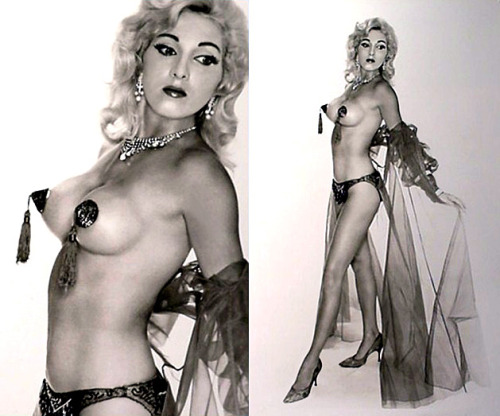
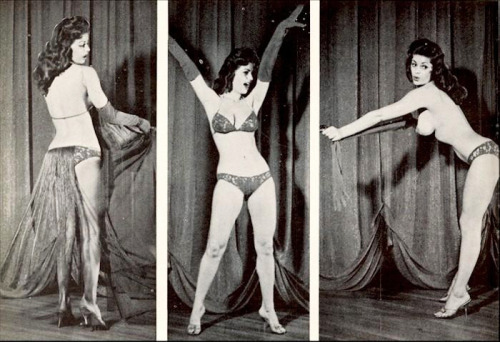
1960's Burlesque Dancers: Neptuna and Miss Beverly Hills
Decades
passed. Burlesque was outdated and passe: something of the past,
relegated to a handful of costumes, props and memories. A dancer from
the American hey-day, Miss Dixie Evans (known then as the Marilyn
Monroe of Burlesque!) began collecting some of these together,
eventually creating a small museum, called The Burlesque Hall of
Fame. As a way of drawing visitors to this small attraction in Las
Vegas, Miss Evans held what would become an annual pageant. In 1991,
the first Miss Exotic World Pageant was held, and won by the dancer
Toni Alessandrini. In 1992, Catherine D'Lish was crowned Queen, and
the pageant itself has grown in international popularity ever since –
fuelled by a generation nostalgic for the lost glamour of a bye-gone
era and grown tired of the gratuitous displays of nudity available in
any corner-shop or at the click of a mouse button.

Dixie Evans - The Marilyn Monroe of Burlesque


Toni Alessandrini ** Catherine D'Lish

Burlesque Hall of Fame Museum in Las Vegas
Now
often called Neo-Burlesque, we are seeing a rise in popularity
unrivalled at any point in history. Cabaret and Burlesque shows are
thriving in an unprecedented way, reaching new audiences and gaining
new fans all the time. In America, touring Burlesque troupes and
dancers entertain vast audiences as they travel across the US; in
France the Moulin Rouge is as popular now as it was during the Belle
Epoque; and in England cabaret and variety shows are available in
almost every city in the country!

Immodesty Blaize


Roxi D'Lite ** Kiki Kaboom


Marni Scarlett ** Narcissister
The
term encompasses an increasingly wide-range of performance styles:
classic-striptease, comic acts, singing and circus to name just a
few, honouring traditions of the past while pushing the boundaries to
new and exciting pastures.


Jett Adore ** Satans Angel


Empress Stah ** Scotty the Blue Bunny
I
don't know where burlesque will go in the future: will we go
full-cycle again as audiences become hungry for more; smaller
costumes, quicker reveals or increasing nudity, and raunchier
routines? Will there be a a return to a more traditional, vaudeville
format: where the burlesque dancer is merely a part of a longer
variety show, alongside other styles of performance? Will audiences
simply get bored as a new technology rises to take the place of live
entertainment as happened with cinema and television? Will one style
of burlesque die out as another takes its place – such as the smoky
cabaret club being super-ceded by the spectacular stage production of
a burlesque-inspired revue, or vice-versa? All of these scenarios
have possibility: there are contemporary and historical examples of
all of these situations being played out and it is barely possible to
say where burlesque will be in another ten, twenty, fifty or
one-hundred years. Maybe even a thousand years in the future, people
will look back through history to our modern style of cabaret and
reference this era as we do the Ancient Greeks or the Italian
Commedia; as part of a long and varied tradition of burlesque theatre
whose roots are deep and branches still growing...
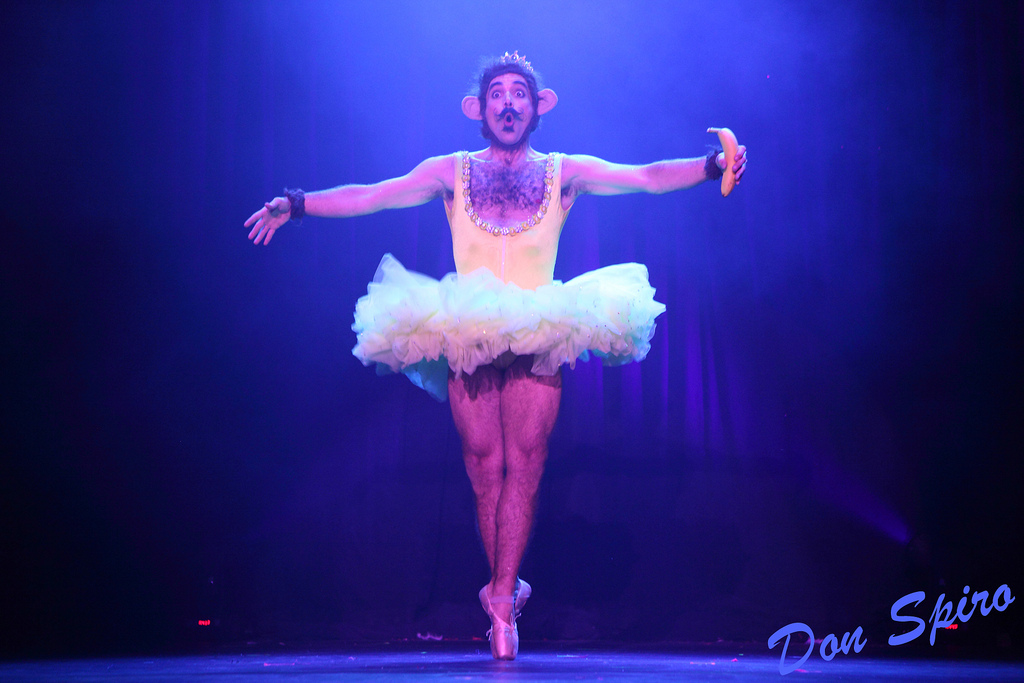

The Evil Hate Monkey ** Dirty Martini
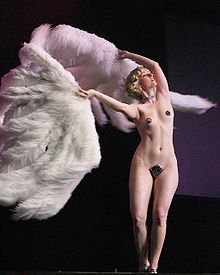

Michelle L'Amour ** Kittie Klaw


SallyRand ** Tigger


Lili St. Cyr ** Kitten Deville
Sources
Wikipedia Articles: Burlesque, Neo-Burlesque, Harlequin, Commedia dell'arte, Pantomime, Victorian Music Hall, Lysistrata, Aristophanes, Burlesque Hall of Fame,
Burlesque Bible Magazine: Issue One (articles by Jo Taylor and Kittie Klaw)
Burlesque and the art of the Teese: Dita von Teese
It's Behind You! A History of Pantomime


